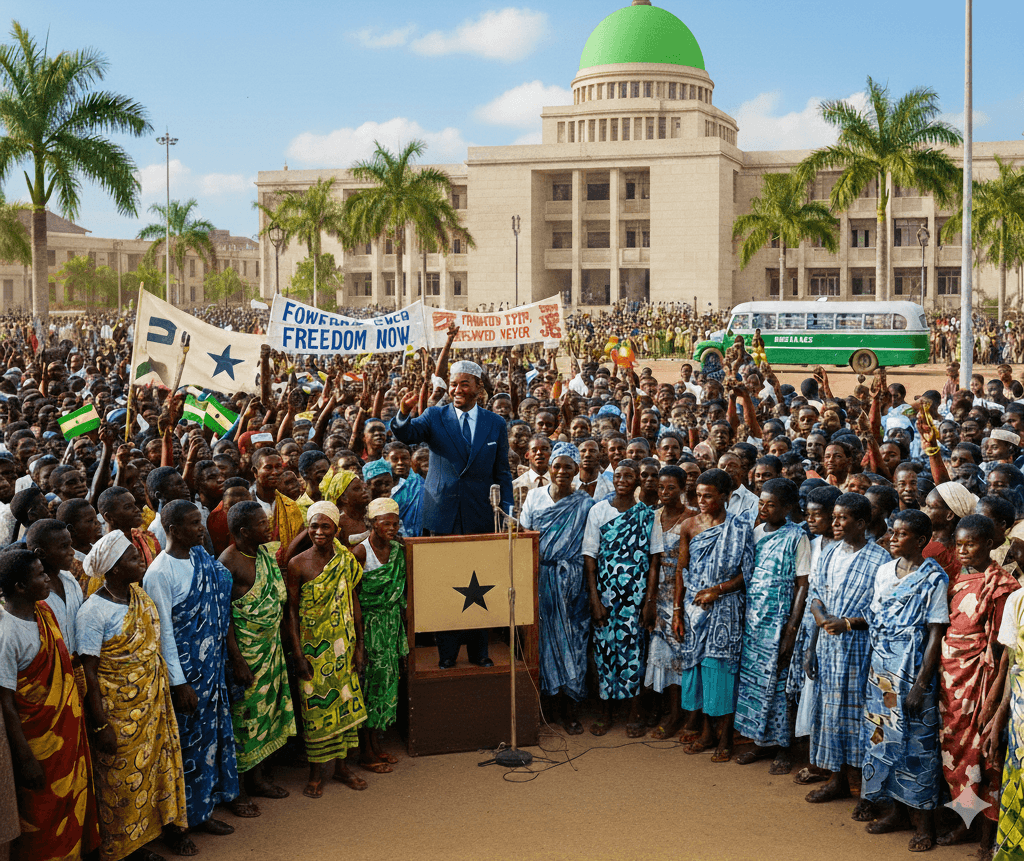
The aftermath of the Second World War crippled European colonial powers, serving as a turning point that empowered nationalist movements across Africa in subsequent years. The Atlantic Charter of 1941, with its emphasis on self-determination, and the Fifth Pan-African Congress in 1945, further bolstered the African nations’ demands for sovereignty.
The desire to break free from British control became so intense that, at times, freedom itself was prioritized over the quality of self-governance. As Nkrumah famously stated, ‘It is far better to be free to govern or misgovern yourself than to be governed by anybody else.’ Whether this stance arose from a lack of appreciation of the responsibilities that accompany genuine independence, or from indifference so long as colonial rule ends, it is undeniable that Ghana—and Africa more broadly—has paid a heavy price for this attitude, either through ignorance or neglect.
This raises an important question: how should a society measure its success? What are the true indicators of national progress; is it by wealth, technological advancement, economic growth, or scientific explorations?
Shortly after Ghana’s independence in 1957, improvements in public health, access to education, social utility, and the ability to self-governance became the measure for progress. The benchmarks are commendable, yet they overlook a crucial element: the moral health of the citizenry. Regardless of a nation’s resource wealth or intellectual prowess, true progress remains elusive if its moral fabric is frayed.
This insight is echoed by Kahlil Gibran, who observed that ‘a nation’s true wealth lies not in gold or silver, but in the knowledge, wisdom, and integrity of its people’. Similarly, Professor PLO Lumumba argues that the “Third World” is fundamentally a mental condition; without a shift in mindset, Africa risks remaining trapped in underdevelopment.
Adversarial Politics
Between 1957 and 1981, Ghana experienced the toppling of four elected governments, leading to significant setbacks in democratic stability. The actors involved at the time viewed these coups as necessary tools for influence and legitimate avenues to power, ultimately resulting in a political class that experimented with Ghana’s fragile democracy.
Speaking at the Independence Day parade on March 6, 2025, President Mahama reiterated the drawbacks of coups on Ghana’s economic growth. ‘Nkrumah envisioned an industrialized Ghana where citizens enjoyed high living standards rooted in patriotism and Pan-African unity. But on February 24, 1966, that dream was shattered, setting us back for decades,’ he said (Graphic Online, 2025).
While several developed nations transcend partisan interests to foster growth through continuity of common interest, Ghana’s development frequently stalls after grand launches and media rhetoric. This reality contrasts with the idea that ‘the African is capable of managing his own affairs.’
According to the Auditor-General’s report, approximately GHC52.9 million was spent on infrastructure projects between 2016 and 2024—including schools, health facilities, and market sheds. However, these assets remain non-operational, calling into question the state of governmental continuity. The Ghanaian political system continues to be hampered by a highly polarised multiparty structure and ideological rigidity, which frequently undermine national cohesion and bipartisan cooperation.
Self Determination
Ghana, like many other African nations, is a resource-rich country, boasting minerals, timber, oil, and water. However, the benefits of these resources elude its economy and people due to a lack of skills and knowledge regarding natural resource governance. This has led to self-defeating bargaining positions—epitomized by the ‘half a loaf is better than none’ epigram—where foreign corporations are allowed to extract and reap the rewards while the African people receive virtually none of the loaf.
A decade after the discovery of oil, foreign interests continue to dominate local competition despite the passage of local content and participation regulations. Even after the passing of LI 2204 and LI 2431, non-Ghanaian stakes in mineral and oil resources remain disproportionately high.
A 2023 report by African Leadership Magazine identified the top ten oil companies and their subsidiaries as the dominant players in Ghana’s industry, with foreigners controlling the vast majority of shares. One would expect that a nation pursuing post-independence goals of self-determination would have made greater strides in exploring and utilizing its resources through home-grown technology, skilled labor, and technical competence.
Human Resource Development
In his book The Diagnosis, Dr. Joshua Oppong Sarfo notes that, “Nations are successful, not because of their natural resources or their geographical locations. Nations are successful based on the quality of their value systems. Weak values beget weak nations; poor values beget poor nations and quality values beget rich nations”. A question frequently posed is why Ghana has failed to prosper despite its abundance of natural resources. I am in complete agreement, particularly regarding the prevalent narrative of resource-rich African nations that spiral into poverty and resource-induced conflict, despite the opportunities such wealth presents. This compels me to question what a ‘resource’ actually entails.
Ellen G. White notes in her popular quote, ‘the greatest want of the world is the want of men who will not be bought or sold, men who in their inmost souls are true and honest, men who do not fear to call sin by its right name, men whose conscience is as true to duty as the needle to the pole, men who will stand for the right though the heavens fall’.
I would further contend that until human capacity is intentionally cultivated, the inherent value of the natural environment remains squandered, often at the nation’s own expense. While a country may be endowed with vast mineral and natural resource deposits, it requires a robust value system and a collective social conscience to truly flourish. Attributes such as professional competence, resilience, humility, innovation, and civic-mindedness are the catalysts that propel a nation from mediocrity to advancement.
A Strong State in its Own Rights
Comparisons with other nations often fail to justify the theories and propositions proffered here. Even in the world’s most advanced countries, social challenges persist—ranging from corruption and crime to systemic injustice. Therefore, these arguments are not intended to expose Ghana’s broken systems by comparing them to other nations, but rather to analyze them on their own terms.
This is a call for an awakening—a reminder of where we stand and what we can become. A fractured political system defined by entrenched opposition, a reliance on foreign technology that stifles local innovation, and decayed moral values that favor parochial interest, nepotism, and greed have never built a strong nation. Ghana does not need another Nkrumah to fight for independence; rather, Ghana needs all its citizens to stand up for the nation’s goals, aspirations, and true potential.
Author:
Nana Kwame Barima Baidoo
Research Associate,
Global Futures Institute.